
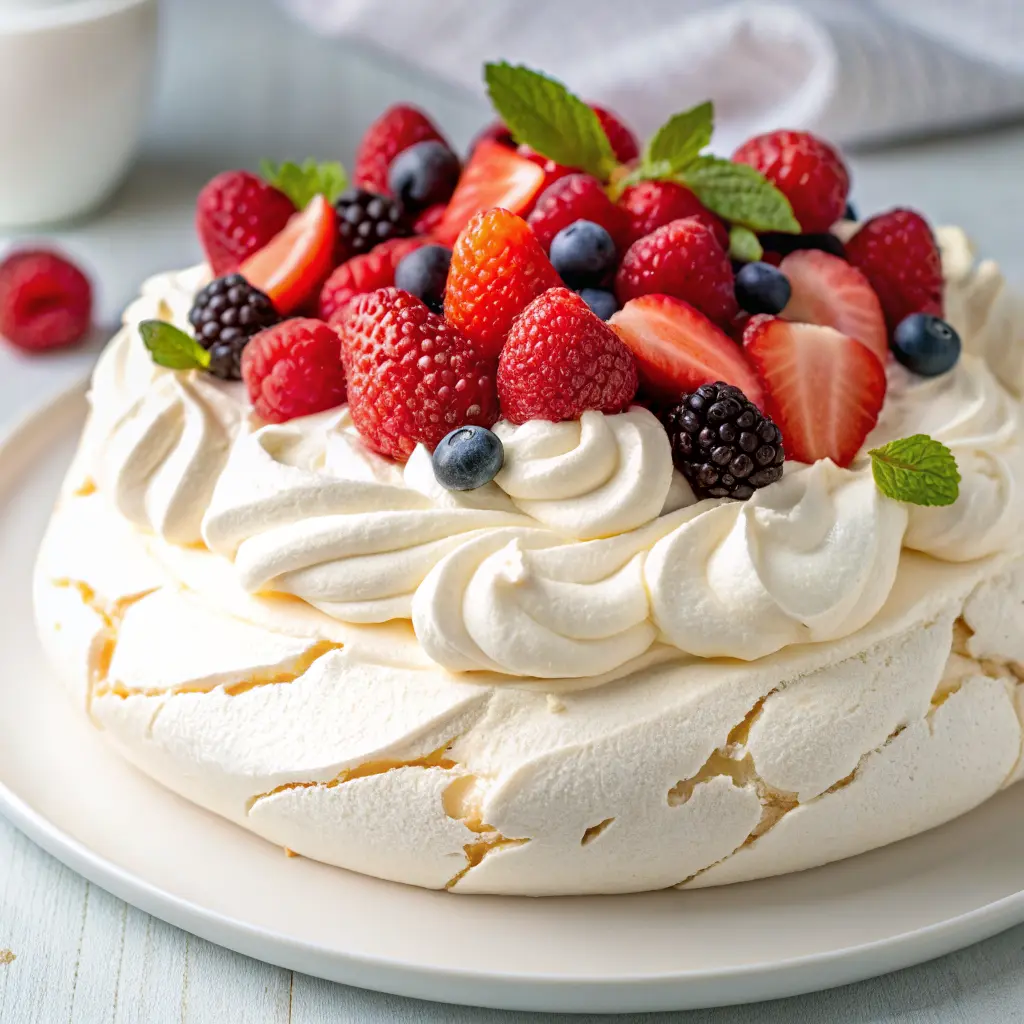
What Is Pavlova Cake?
Pavlova Cake is a meringue-based dessert that bakes into a crisp outer shell with a soft, marshmallow-like center. It’s typically topped with:
- a generous layer of whipped cream
- fresh fruit (berries, kiwi, passionfruit, mango—anything bright and juicy)
- optional sauces like lemon curd or berry coulis
Think of it as a “cake” in the way it slices and serves like a cake, but the base is meringue, not sponge.
Why This Dessert Works (Even If You’re New to Meringue)
Pavlova has a reputation for being tricky, but it’s really just a few controllable steps:
- You build a strong foam with egg whites
- You stabilize it with sugar (added slowly)
- You shape it into a tall “nest”
- You bake it low and slow
- You cool it gently so it keeps its shape
Once you know what each ingredient does, pavlova becomes more predictable—and honestly, more fun.
Pavlova Cake vs. Meringue: What’s the Difference?
They’re related, but not identical.
Classic dry meringue cookies
- usually bake until fully dry
- crisp all the way through
- snap when you bite them
Pavlova Cake
- crisp outside, soft center
- designed to be topped and sliced
- intentionally “cloud-like” inside
So if your pavlova is a little chewy in the middle, that can be exactly right—depending on the style you’re aiming for.
Ingredients for Pavlova Cake
A great pavlova uses a short ingredient list, but each item has a job.
1) Egg whites
The structure of pavlova is built on whipped egg whites.
Best practices:
- Separate eggs while cold (easier separation), then let whites come to room temp to whip.
- Avoid any yolk—fat prevents a strong foam.
- Use a clean, dry bowl (no grease, no moisture).
2) Sugar
Sugar stabilizes the foam and creates that glossy, thick meringue.
Tips:
- Superfine/caster sugar dissolves more easily.
- Add sugar slowly so it doesn’t deflate your foam.
- You want a glossy mixture that feels smooth—not gritty.
3) Acid (vinegar or lemon juice) or cream of tartar
Acid helps stabilize the whipped whites.
Common options:
- white vinegar
- lemon juice
- cream of tartar
4) Cornstarch (cornflour)
This is the “pavlova signature” ingredient in many recipes. It helps create that soft center while maintaining structure.
5) Vanilla + a pinch of salt
- Vanilla rounds out the sweetness.
- Salt makes the flavor feel balanced and less one-note.
Tools You’ll Want
You don’t need a professional kitchen. This list keeps the process smooth:
- stand mixer or hand mixer
- large clean mixing bowl
- parchment paper
- baking tray
- spatula
- spoon (for shaping)
- oven thermometer (optional but helpful)
Step-by-Step: How to Make Pavlova Cake
Step 1: Prep the oven and pan
- Preheat to a low temperature (commonly 120°C / 250°F, depending on your oven).
- Line a tray with parchment.
- If your oven runs hot, reduce slightly—pavlova hates excess heat.
Step 2: Whip egg whites to soft peaks
Start on medium speed until the whites look foamy, then increase speed.
You’re aiming for:
- soft peaks that slump gently
- a white foam that holds shape briefly
Step 3: Add sugar slowly (the most important step)
This is where most pavlovas go wrong—usually by rushing.
Do this:
- add sugar 1 tablespoon at a time
- wait 10–15 seconds between additions
- keep mixing until glossy
How to know it’s ready:
- rub a little meringue between your fingers
- if it feels gritty, keep mixing
- if smooth, you’re good
Step 4: Add cornstarch + acid + vanilla
Add gently and briefly—just to combine.
- cornstarch
- vinegar or lemon juice
- vanilla
- pinch of salt
Avoid overmixing here; you want to retain all the air you’ve incorporated.
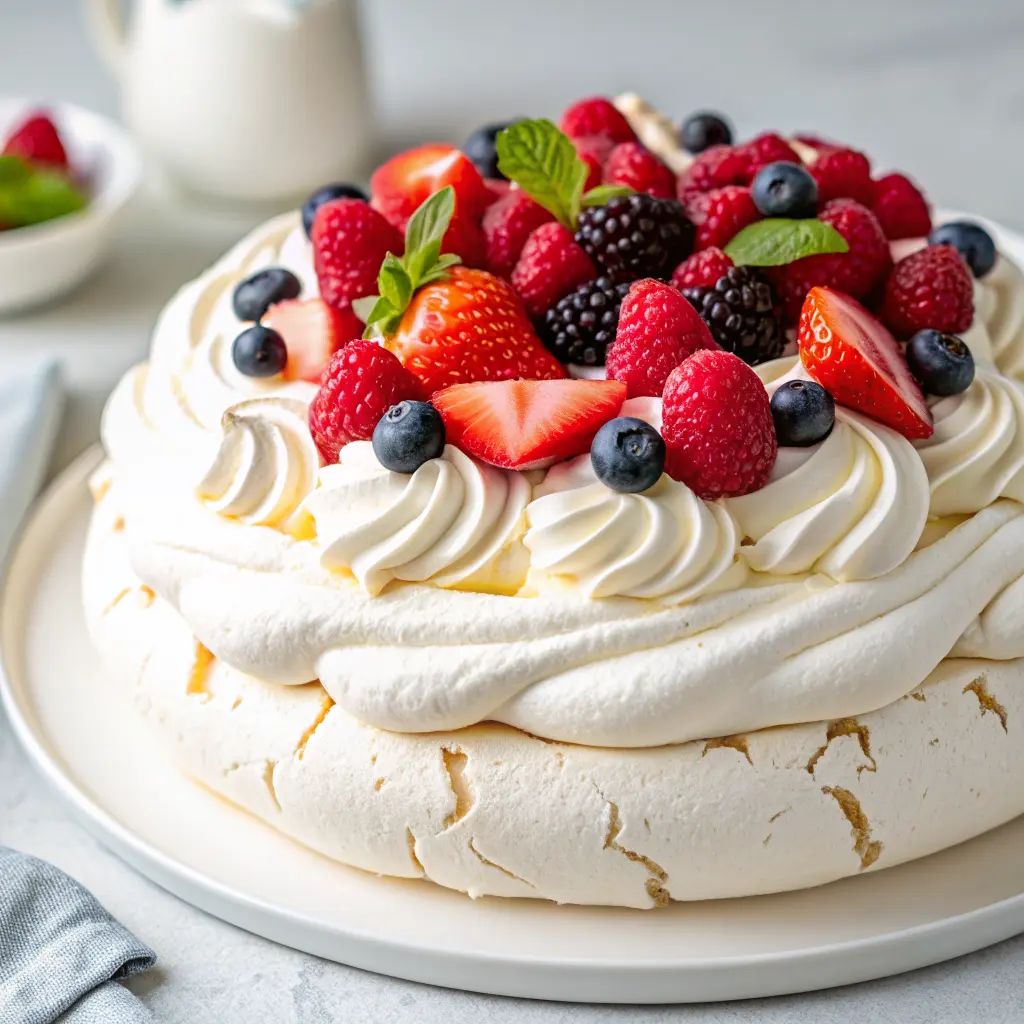
Step 5: Shape the pavlova “nest”
Spoon the meringue onto the circle guide.
Good shaping moves:
- pile it tall in the center first
- then spread outward to the edges
- Create a slight dip in the middle for toppings
- swirl the sides upward (extra height looks dramatic)
Optional pro look:
- Use a spoon to make soft swoops and peaks around the edge
Step 6: Bake low and slow
Bake until the outside feels set and dry.
General cues:
- The surface should look matte (not wet)
- It should feel firm when gently tapped
Step 7: Cool slowly (don’t rush this)
Turn off the oven and let the pavlova cool to room temperature.
Best cooling method:
- Switch the oven off
- leave the door closed (or slightly ajar if your oven traps heat)
- cool for 1–2 hours
Slow cooling helps reduce dramatic cracking and collapsing.
Classic Pavlova Cake Toppings (The Best Combinations)
The meringue base is sweet, so toppings that bring brightness and tang are ideal.
Classic topping set
- whipped cream
- strawberries + blueberries
- kiwi slices
- passionfruit pulp
Easy topping upgrades
- lemon curd drizzle
- berry coulis
- shaved chocolate
- toasted coconut
- chopped pistachios
A simple rule:
- soft + creamy + fresh fruit + something punchy (curd, sauce, zest)
How to Assemble Pavlova Cake (Without Losing the Crunch)
Pavlova is happiest when assembled close to serving.
Best practice timeline
- Make pavlova shell: earlier in the day or the day before
- Whip cream: up to a few hours before
- Slice fruit: just before serving
- Assemble: 30–90 minutes before serving (or right before, for maximum crispness)
Assembly steps
- Place cooled pavlova on a serving platter
- Spoon on whipped cream (don’t spread too aggressively)
- Add fruit in layers for height
- Finish with sauce drizzle and a few mint leaves
Troubleshooting Pavlova Cake
If pavlova has ever intimidated you, this section is your safety net.
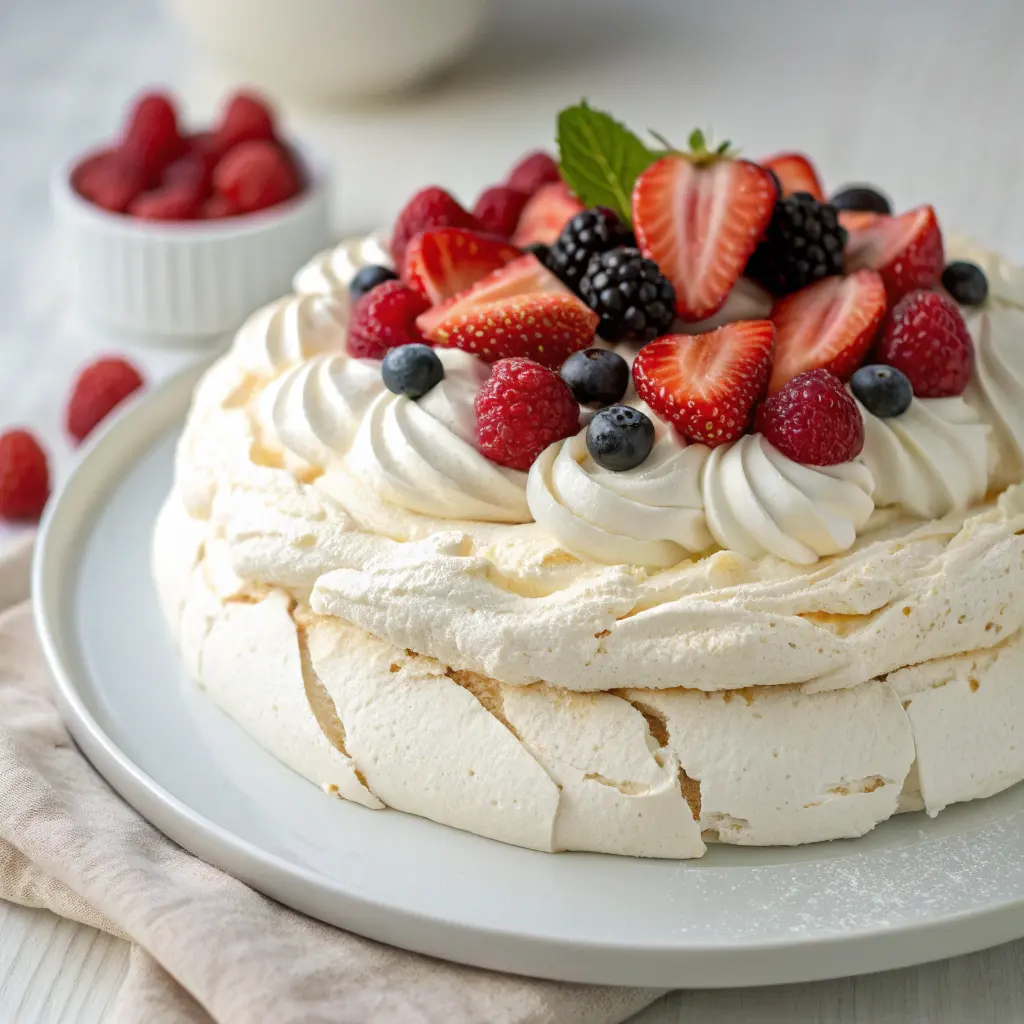
1) “Why did my pavlova crack?”
Cracks are common and usually harmless.
Common causes:
- temperature changes (hot oven → cool air too fast)
- overbaking the shell
- shaping too tall without support
How to minimize:
- bake at a low, steady temp
- cool gradually in the oven
- don’t move it while warm
2) “Why is it sticky or sweaty?”
Sticky pavlova often comes from:
- sugar not fully dissolved
- humid weather
- storing the shell in the fridge uncovered
Solutions:
- use caster/superfine sugar
- add sugar slowly
- mix until completely smooth (no grit)
- store unassembled shell in a dry container at room temp
3) “It collapsed—what happened?”
A little settling is normal, but big collapse usually means:
- underbaked center
- door opened too early
- meringue foam wasn’t stable enough
Prevention tips:
- don’t rush baking
- avoid opening the oven
- make sure meringue is glossy and thick before baking
4) “It’s brown on top.”
That’s almost always heat.
Fix:
- lower oven temp
- consider moving tray to a higher rack position (or away from hot spots)
- use an oven thermometer if your oven runs hot
5) “My meringue is grainy.”
Usually:
- sugar added too fast
- not enough mixing time after adding sugar
Fix:
- slow sugar addition
- keep mixing until smooth and glossy
Make-Ahead Tips: How to Plan Pavlova Cake for Events
Want pavlova for a party without stress? Use this plan.
Make the shell ahead
- Make the pavlova shell the day before
- Cool completely
- Store in an airtight container at room temperature
Prep toppings ahead
- Wash berries and dry them well
- Mix sauces (curd/coulis) and chill if needed
- Keep fruit slicing closer to serving for best texture
Assemble last minute
If you want maximum crunch, assemble right before serving.
Storage (Shell vs Assembled)
Storing the shell (best option)
- room temperature
- airtight container
- away from steam, heat, and moisture
Storing assembled pavlova
Once topped with whipped cream and fruit, it starts to soften.
If you must store it:
- refrigerate
- cover gently (avoid smashing toppings)
- expect the shell to soften by the next day (still tasty, just less crisp)
FAQs (People Also Ask–Style)
Is Pavlova Cake supposed to be soft in the middle?
Yes—many pavlovas are designed with a crisp shell and a soft, cloud-like center. If you want it drier throughout, bake a bit longer at a low temperature, then cool slowly.
Why did my pavlova crack?
Cracks often happen from temperature changes or slight overbaking. Cooling slowly helps. Also: cracks are normal and look gorgeous once topped.
Why is my pavlova sticky?
Sticky usually means sugar didn’t fully dissolve, humidity is high, or the shell was stored where it absorbed moisture. Add sugar slowly and mix until smooth.
Can I make Pavlova Cake the day before?
Absolutely. Make the shell, cool completely, and store airtight at room temperature. Add cream and fruit close to serving.
How do I know when it’s done baking?
The outside should feel dry and set. The inside may still be soft—especially if you’re aiming for that classic pavlova center.
Conclusion
Pavlova Cake is the kind of dessert that looks dramatic but becomes surprisingly simple once you master the slow sugar method and the low-and-slow bake. Focus on a clean bowl, glossy meringue, and gentle cooling—and you’ll get that signature crisp shell with a soft, cloud-like center every time.
Print
Irresistible Pavlova Cake (Crisp Shell + Cloudy Center) — Easy Showstopper Recipe
- Total Time: PT2H00M
- Yield: 8 servings 1x
- Diet: Gluten Free
Description
This Pavlova Cake is a stunning dessert featuring a crisp, cloud-like meringue shell with a soft, marshmallow-like center, topped with billowy whipped cream and fresh fruit. Light, elegant, and naturally beautiful, pavlova is perfect for celebrations and holidays.
Ingredients
For the Pavlova Meringue
- 4 large egg whites, room temperature
- 1 cup granulated sugar (superfine preferred)
- 1 tsp cornstarch
- 1 tsp white vinegar or lemon juice
- 1 tsp vanilla extract
- Pinch of salt
For the Topping
- 1 ½ cups heavy whipping cream, cold
- 2 tbsp powdered sugar
- 1 tsp vanilla extract
- 2–3 cups fresh fruit (strawberries, blueberries, raspberries, kiwi, passion fruit)
Instructions
1. Prepare the Oven
- Preheat oven to 250°F (120°C).
- Line a baking sheet with parchment paper.
- Draw an 8-inch circle on the parchment and flip it over.
2. Make the Meringue
- Beat egg whites with salt on medium speed until soft peaks form.
- Gradually add sugar, 1 tablespoon at a time, beating on high until stiff, glossy peaks form (5–7 minutes).
- Beat in vanilla, vinegar, and cornstarch just until combined.
3. Shape the Pavlova
- Spoon meringue into the drawn circle.
- Shape into a round cake, smoothing sides and creating a shallow dip in the center.
- Make decorative swirls if desired.
4. Bake
- Bake for 1 hour 15 minutes.
- Turn off oven and let pavlova cool completely inside with door slightly open (at least 1 hour).
- Do not open the oven while baking to avoid cracks.
5. Whip the Cream
- Beat cold heavy cream, powdered sugar, and vanilla until soft peaks form.
6. Assemble
- Transfer cooled pavlova to a serving plate.
- Spoon whipped cream into the center.
- Top with fresh fruit just before serving.
Notes
- Humidity affects pavlova—dry days work best.
- Fine sugar dissolves better for a smooth meringue.
- Cracks are normal and part of pavlova’s charm.
- Prep Time: PT20M
- Category: Desserts
- Method: Baked
- Cuisine: Australian
Nutrition
- Serving Size: 1 slice
- Calories: 230kcal
- Sugar: 26g
- Sodium: 60mg
- Fat: 12g
- Saturated Fat: 7g
- Unsaturated Fat: 5g
- Trans Fat: 0g
- Carbohydrates: 28g
- Fiber: 1g
- Protein: 4g
- Cholesterol: 45mg