
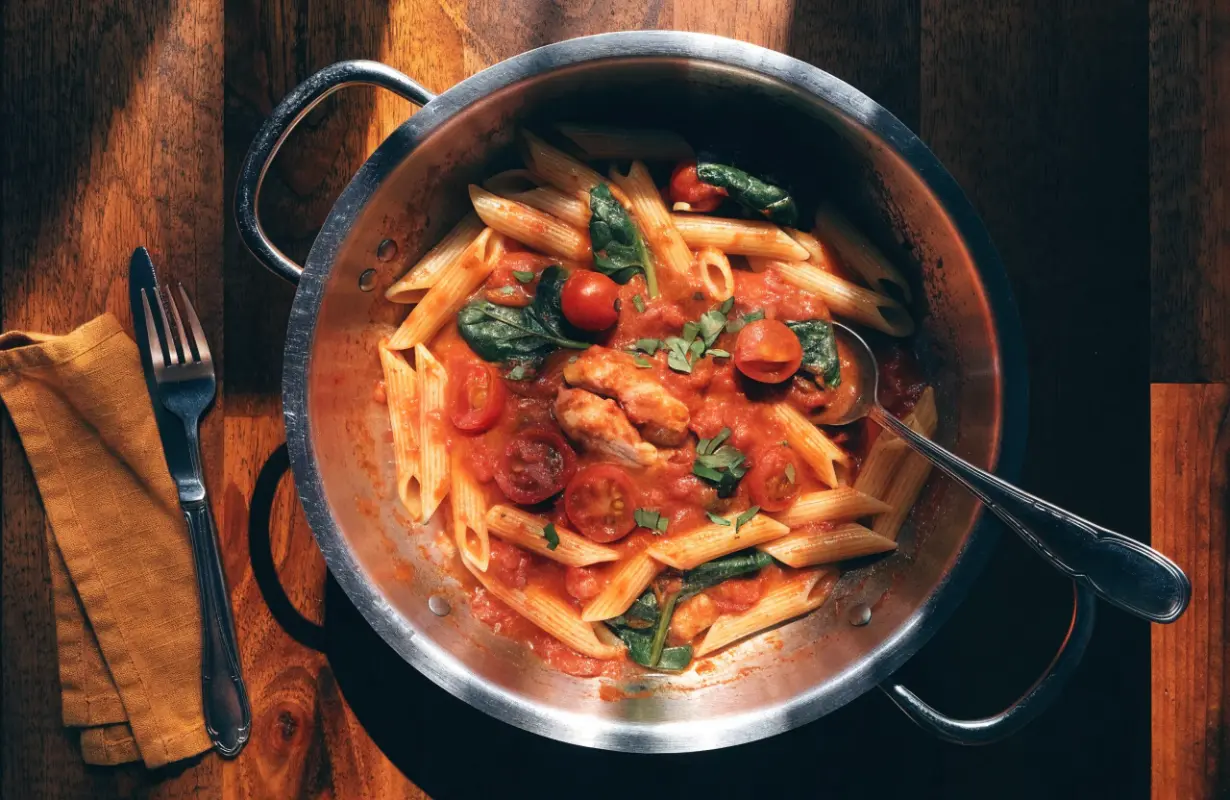
If you need an easy dinner that feels homemade without leaving a sink full of dishes, this One-Pan Tomato & Spinach Chicken Pasta is a recipe worth keeping close. Tender pieces of chicken, pasta, juicy tomatoes, garlic, and fresh spinach come together in one skillet for a flavorful meal that is simple enough for a busy weeknight. The pasta cooks right in the pan, allowing it to soak up the tomato sauce and savory flavors as it becomes tender.
The secret to a great pasta dish is getting the texture right. If you want a useful guide to cooking pasta properly, especially when aiming for that firm al dente texture, check out Barilla’s pasta cooking tips. For this recipe, you don’t need a separate pot of boiling water because the pasta cooks directly in the skillet with the tomatoes and broth.
Why You’ll Love This One-Pan Chicken Pasta
There are plenty of chicken pasta recipes, but this one stands out because the cooking process is particularly straightforward. You don’t have to boil the pasta separately, make a sauce in another saucepan, and then combine everything at the end.
Everything happens in one large skillet.
Here are a few reasons to add this one-pan chicken pasta to your weeknight rotation:
- One pan means less cleanup. The chicken, sauce, pasta, and spinach all cook together.
- The pasta absorbs the sauce. Instead of simply adding cooked pasta to tomato sauce, the pasta cooks directly in the flavorful liquid.
- The chicken gets browned first. This creates savory browned bits in the bottom of the pan that become part of the sauce.
- The ingredients are easy to find. Chicken, pasta, canned tomatoes, spinach, garlic, onion, and broth are all you need for the basic recipe.
- It’s easy to customize. You can switch the pasta shape, add vegetables, make the sauce spicy, or finish the dish with Parmesan.
- It works well for busy evenings. Most of the cooking happens in a single skillet with very little hands-on work.
- The leftovers are easy to reheat. A splash of broth or water can loosen the sauce when reheating.
The combination of tomatoes and spinach also gives the dish plenty of contrast. The tomatoes create a rich, slightly tangy sauce, while the spinach adds a fresh finish. Garlic, onion, Italian seasoning, and Parmesan round everything out.
What Makes This Tomato Spinach Chicken Pasta So Flavorful?
The key isn’t one complicated ingredient. It’s the order in which the ingredients are cooked.
First, the chicken is seasoned and browned in olive oil. Don’t rush this step. Letting the chicken make direct contact with the hot skillet creates a golden exterior and leaves flavorful browned bits behind.
Next comes the onion and garlic. Cooking them in the same pan means they pick up all those savory flavors left behind by the chicken.
The tomatoes then provide the foundation for the sauce. As they simmer with chicken broth, their juices combine with the browned bits, garlic, onion, and seasonings.
Then comes the pasta.
Instead of cooking the pasta separately, you’ll add it directly to the skillet. As it simmers, the pasta absorbs some of the tomato mixture. The starch released from the pasta also helps the sauce become thicker and more cohesive.
Finally, fresh spinach goes in near the end. Spinach wilts very quickly, so there’s no reason to cook it for the entire duration of the recipe.
The result is a tomato-rich chicken pasta where every component tastes connected rather than simply tossed together.
Ingredients You’ll Need
Here’s everything you need to make this one-pan tomato and spinach chicken pasta.
Chicken
Use boneless, skinless chicken breasts cut into bite-sized pieces.
Chicken thighs are also an excellent substitute if you prefer darker meat. They have a slightly richer flavor and are more forgiving if they cook for an extra minute or two.
Try to cut the chicken into pieces that are roughly the same size. This helps them cook at approximately the same rate.
Pasta
Penne is an excellent choice because its hollow center and ridged exterior hold onto the tomato sauce.
You can also use:
- Rotini
- Fusilli
- Rigatoni
- Ziti
- Small shells
- Cavatappi
Short pasta shapes are generally easiest for this particular one-pan method.
Tomatoes
Canned diced tomatoes are convenient and dependable.
Use tomatoes packed in juice rather than heavily drained tomatoes because the liquid contributes to the cooking broth for the pasta.
You can also use crushed tomatoes if you prefer a smoother sauce.
Fresh Spinach
Baby spinach is particularly convenient because the leaves are tender and wilt quickly.
If you’re using larger spinach leaves, roughly chop them before adding them to the skillet.
Onion
Yellow onion works beautifully here, although white onion or shallot can also be used.
The onion adds sweetness and depth to the tomato sauce.
Garlic
Fresh minced garlic gives the sauce its characteristic savory flavor.
For a stronger garlic flavor, use four cloves. For a milder version, three cloves are enough.
Chicken Broth
Chicken broth forms part of the cooking liquid for the pasta.
It also gives the sauce more depth than water alone.
Olive Oil
Use olive oil to brown the chicken and sauté the aromatics.
Seasonings
A simple combination works best:
- Italian seasoning
- Salt
- Black pepper
- Red pepper flakes, optional
- Dried oregano, optional
Parmesan
Freshly grated Parmesan is optional but highly recommended as a finishing ingredient.
It adds a salty, savory flavor and helps make the sauce feel richer.
Fresh Basil
A handful of chopped fresh basil makes an excellent finishing touch.
If you don’t have basil, fresh parsley works well too.
How to Make One-Pan Tomato & Spinach Chicken Pasta
Step 1: Prepare the Chicken
Pat the chicken dry with paper towels.
Cut it into bite-sized pieces and season with:
- Salt
- Black pepper
- Italian seasoning
- A pinch of red pepper flakes, if desired
Try to season the chicken evenly so every piece gets a little of the herb mixture.
Set the chicken aside while you prepare the skillet.
Step 2: Brown the Chicken
Place a large, deep skillet over medium-high heat.
Add the olive oil and allow it to heat for a moment.
Add the seasoned chicken in a single layer.
Avoid piling all the chicken into a small area of the pan. If the skillet is crowded, the chicken will release moisture and may steam instead of developing a golden exterior.
Cook the chicken for several minutes, turning occasionally, until browned on the outside.
You don’t necessarily need to cook it to the final stage at this point because it will return to the skillet later.
Transfer the chicken to a clean plate.
Leave the flavorful browned bits in the skillet.
Step 3: Cook the Onion
Reduce the heat slightly and add the chopped onion to the same skillet.
If the pan looks dry, add a small drizzle of olive oil.
Cook the onion for approximately two to three minutes, stirring occasionally.
You want it to soften and become lightly translucent.
As it cooks, scrape the bottom of the pan gently with a wooden spoon or spatula.
Those browned pieces are full of flavor and will become part of the tomato sauce.
Step 4: Add the Garlic
Add the minced garlic.
Cook for approximately 30 seconds to one minute.
Keep an eye on it because garlic can burn quickly.
You want the garlic to become fragrant without turning dark.
If you’re using red pepper flakes, add them now so their flavor spreads through the oil and sauce.
Step 5: Build the Tomato Base
Add the canned diced tomatoes with their juices.
Pour in the chicken broth.
Stir everything together, scraping the bottom of the pan as you go.
Bring the mixture to a gentle simmer.
At this point, the skillet should smell noticeably more like a tomato sauce rather than simply cooked chicken and onions.
Taste the liquid and adjust the seasoning if necessary.
Step 6: Add the Pasta
Add the uncooked pasta directly to the skillet.
Stir it into the tomato mixture.
The pasta should be surrounded by liquid as much as possible.
Bring the mixture back to a gentle simmer, then reduce the heat enough to maintain steady bubbling without letting the sauce boil aggressively.
Cover the skillet if your pasta shape needs additional help cooking evenly.
Stir every couple of minutes.
This is important because pasta can settle against the bottom of the skillet and stick as the liquid gets absorbed.
Step 7: Check the Pasta
Start checking the pasta several minutes before the cooking time you would normally expect from the package.
The exact cooking time will depend on the pasta shape, skillet size, heat level, and amount of liquid.
You want the pasta to be tender but still have a slight firmness when you bite into it.
If the skillet becomes dry before the pasta is tender, add a small splash of chicken broth or water.
Don’t add a large amount at once.
A little liquid is much easier to incorporate than trying to fix a watery sauce later.
Step 8: Return the Chicken
Once the pasta is nearly tender, return the browned chicken to the skillet.
Stir it into the tomato sauce.
Continue cooking for another few minutes so the chicken is heated through and the flavors have a chance to combine.
If the sauce looks too loose, leave the skillet uncovered for a minute or two.
If it looks too thick, add a splash of broth.
Step 9: Add the Spinach
Now add the fresh spinach.
It may look like far too much at first.
Don’t worry.
Spinach wilts quickly.
Use tongs or a large spoon to fold the leaves into the hot pasta.
Within a minute or so, the spinach should soften and blend throughout the dish.
Avoid cooking it for much longer than necessary.
The goal is tender, vibrant spinach rather than completely collapsed leaves.
Step 10: Finish the Pasta
Turn off the heat.
Taste the pasta and adjust the seasoning.
Add freshly grated Parmesan if desired.
Finish with chopped fresh basil, parsley, extra black pepper, or a pinch of red pepper flakes.
Let the pasta sit for a minute or two before serving.
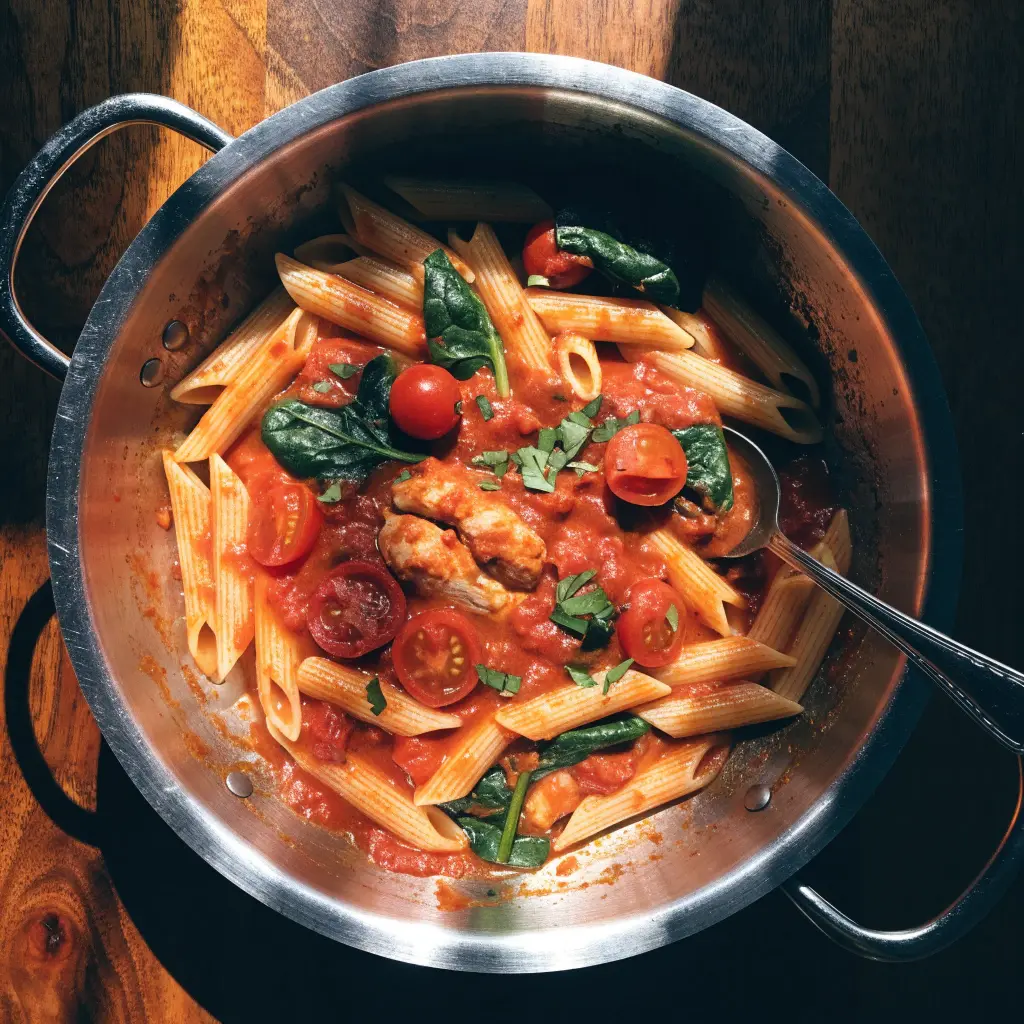
This short resting period allows the sauce to settle and cling more closely to the pasta.
How to Prevent Common Problems
Why Is My Pasta Still Hard?
If the pasta remains firm after the liquid has mostly disappeared, add a splash of broth or water.
Cover the skillet and continue cooking over medium-low heat.
Check it frequently.
The problem may simply be that the skillet is not holding enough liquid for the remaining cooking time.
Why Is My Sauce Watery?
Remove the lid and simmer the pasta for a few extra minutes.
The pasta will continue absorbing liquid, while evaporation will concentrate the sauce.
Avoid adding Parmesan until the consistency is closer to what you want.
Why Did My Chicken Become Dry?
The most common reason is overcooking.
Cutting the chicken into very small pieces can also cause it to cook faster than expected.
For this reason, remove the chicken from the pan after browning and return it later.
Why Did the Pasta Stick to the Pan?
The heat may be too high, the skillet may not contain enough liquid, or the pasta may not have been stirred often enough.
Reduce the heat and stir more frequently.
Why Does My Sauce Taste Flat?
Check the seasoning before adding more ingredients.
Tomatoes often need enough salt to bring out their flavor.
A little black pepper, Italian seasoning, red pepper flakes, Parmesan, or fresh basil can also give the finished dish more character.
Easy Variations and Substitutions
One of the best things about One-Pan Tomato & Spinach Chicken Pasta is how easily you can change it depending on what you have available.
Creamy Tomato Spinach Chicken Pasta
For a creamy variation, stir in a small amount of heavy cream during the final few minutes of cooking.
You can also use half-and-half.
Keep the heat relatively gentle after adding dairy.
Finish with Parmesan for a richer, creamier sauce.
Spicy Tomato Chicken Pasta
For a little heat, add:
- Red pepper flakes
- Crushed chili
- Calabrian chile paste
- A pinch of cayenne
Add the spice when cooking the garlic so the flavor spreads throughout the sauce.
Chicken Thigh Version
Replace the chicken breast with boneless, skinless chicken thighs.
Cut them into similar-sized pieces and brown them in the same way.
The darker meat pairs especially well with the tomato and garlic base.
Rotisserie Chicken Version
If you’re short on time, use shredded or chopped cooked chicken.
Build the tomato pasta first, then stir the cooked chicken in toward the end.
This turns the recipe into an especially quick dinner.
Mushroom Version
Add sliced mushrooms after cooking the onion.
Allow them to cook until their moisture has evaporated and they begin to brown.
Then proceed with the garlic and tomatoes.
Bell Pepper Version
Diced red, yellow, or orange bell peppers can be cooked with the onion.
They add sweetness, color, and another layer of texture.
Sun-Dried Tomato Version
For a stronger tomato flavor, add chopped sun-dried tomatoes.
They work particularly well with spinach, garlic, Parmesan, and chicken.
What to Serve With Tomato & Spinach Chicken Pasta
Because this skillet pasta already contains pasta, chicken, tomatoes, and spinach, you don’t need an elaborate collection of side dishes.
Keep the sides simple.
Garlic Bread
Warm garlic bread is an obvious pairing.
Use it to scoop up the remaining tomato sauce from the plate.
Crusty Bread
A rustic loaf, sourdough, or Italian-style bread works equally well.
Simple Green Salad
A crisp salad with a light vinaigrette gives you a fresh contrast to the warm pasta.
Roasted Vegetables
Roasted broccoli, asparagus, zucchini, or green beans can be served alongside the skillet pasta.
Extra Parmesan
Put a bowl of freshly grated Parmesan on the table so everyone can add as much as they like.
Fresh Basil
A few torn basil leaves immediately before serving can make the finished dish smell and taste fresher.
Storage and Leftovers
One-pan pasta makes excellent leftovers, although the sauce will usually become thicker as it sits.
Transfer leftovers to an airtight container and refrigerate them promptly.
For specific storage guidance, the USDA recommends keeping most cooked leftovers in the refrigerator for 3 to 4 days and provides additional information on freezing and reheating leftovers.
When you’re ready to reheat the pasta, add a small splash of water or chicken broth.
Warm it gently in a skillet over medium-low heat, stirring occasionally.
You can also microwave individual portions.
If the pasta seems dry, don’t add a large amount of liquid at once. Start with one or two tablespoons and stir.
The pasta will absorb some of the liquid as it warms.
For frozen portions, thaw them in the refrigerator before reheating when possible. Add a little liquid during reheating to restore some of the sauce’s original consistency.
Make-Ahead and Meal-Prep Tips
Although this recipe is quick enough to make from scratch on a weeknight, a few preparation steps can make the process even faster.
Before cooking:
- Cut the chicken into bite-sized pieces.
- Chop the onion.
- Mince the garlic.
- Measure the seasonings.
- Drain or prepare any additional vegetables.
- Wash the spinach.
- Grate the Parmesan.
- Measure the broth and tomatoes.
Frequently Asked Questions
Can I use a different type of pasta?
Yes.
Penne, rotini, fusilli, rigatoni, ziti, and small shells are all good options.
The important thing is to monitor the cooking time and liquid level because different pasta shapes absorb liquid at different rates.
Can I use chicken thighs instead of chicken breast?
Absolutely.
Boneless, skinless chicken thighs work very well in this recipe.
Cut them into bite-sized pieces and brown them just as you would chicken breast.
They’ll give the finished pasta a slightly richer flavor.
Can I use frozen spinach?
Yes.
Thaw frozen spinach first and squeeze out as much excess water as possible.
Add it toward the end of cooking.
Because frozen spinach is already softened, it doesn’t need much time in the skillet.
Can I use fresh tomatoes instead of canned tomatoes?
Yes.
Cherry tomatoes, Roma tomatoes, or other ripe tomatoes can be used.
Fresh tomatoes may release a different amount of liquid than canned tomatoes, so you may need to adjust the broth slightly as the pasta cooks.
Can I make this recipe creamy?
Yes.
Add a small amount of heavy cream or half-and-half during the final few minutes.
You can also add Parmesan for a thicker, richer sauce.
Keep the heat moderate after adding dairy and stir frequently.
Final Thoughts
One-Pan Tomato & Spinach Chicken Pasta is the kind of recipe that earns a regular place in the weeknight dinner rotation because the cooking process is straightforward and the ingredients are flexible.