
What Is a Sheet-Pan Thanksgiving Dinner?
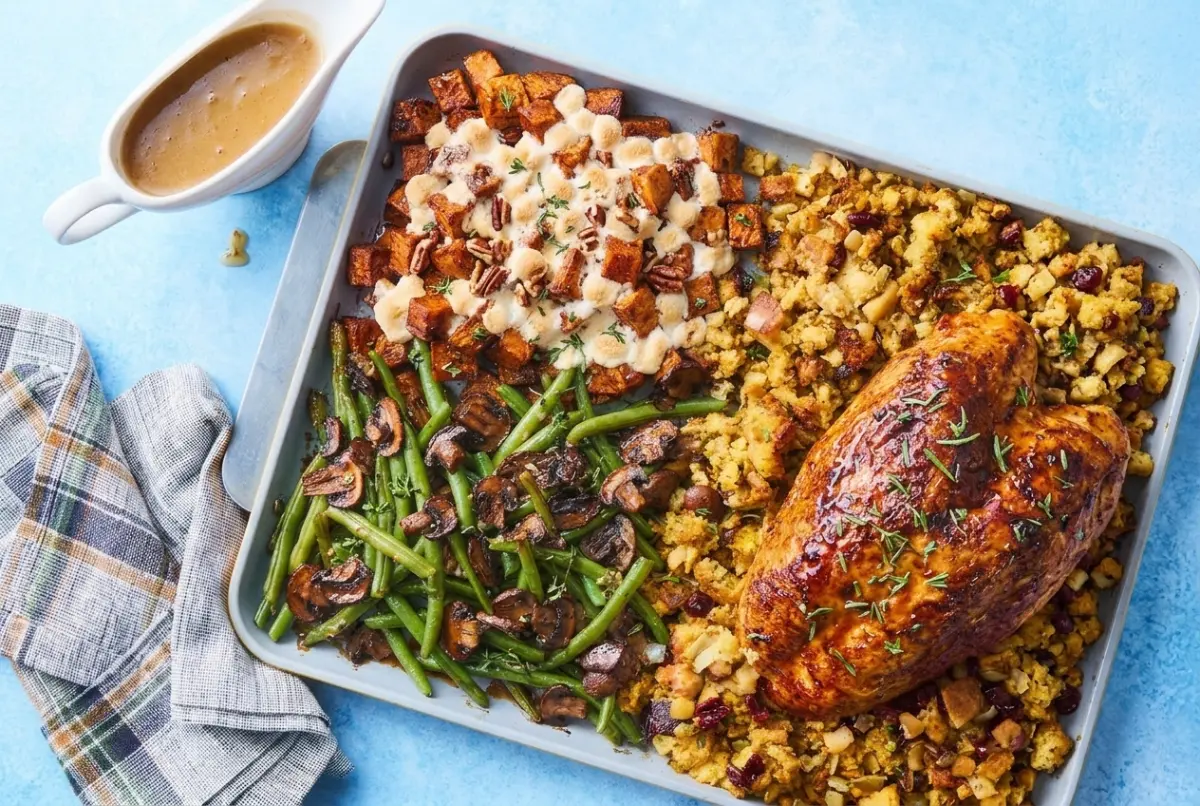
A Sheet-Pan Thanksgiving Dinner is a simplified version of the traditional holiday meal, where several classic dishes are prepared together on one large, rimmed baking sheet. Instead of juggling multiple roasting pans, casserole dishes, and baking trays, you organize the main ingredients into separate sections and cook them in the oven.
The meal typically includes:
- Herb-seasoned turkey breast or turkey tenderloin.
- Savory bread stuffing with onions, celery, and fresh herbs.
- Roasted sweet potatoes with a golden exterior.
- Brussels sprouts or green beans.
- Carrots and other seasonal vegetables.
- Optional cranberries, pecans, and crispy onions.
The secret to making this method successful is understanding that not every ingredient cooks at the same speed. Turkey generally requires more time than smaller vegetable pieces, while stuffing needs enough time to become golden and thoroughly cooked.
Ingredients – Sheet-Pan Thanksgiving Dinner
For the Herb-Roasted Turkey
- 2–3 lb boneless turkey breast or turkey tenderloin
- 3 tablespoons unsalted butter, softened
- 2 tablespoons olive oil
- 3 garlic cloves, minced
- 1 teaspoon fresh rosemary, chopped
- 1 teaspoon fresh thyme leaves
- 1 teaspoon fresh sage, chopped
- 1 teaspoon paprika
- 1 teaspoon salt
- ½ teaspoon black pepper
For the Savory Sheet-Pan Stuffing
- 4 cups dried bread cubes
- ½ cup yellow onion, finely diced
- ½ cup celery, finely chopped
- 3 tablespoons unsalted butter
- ¾–1 cup chicken or turkey broth
- 1 teaspoon dried sage
- ½ teaspoon dried thyme
- ½ teaspoon poultry seasoning
- Salt and black pepper, to taste
For the Roasted Vegetables
- 2 medium sweet potatoes, peeled and cubed
- 1 lb Brussels sprouts, trimmed and halved
- 8 oz fresh green beans, trimmed
- 2 medium carrots, peeled and sliced
- 2 tablespoons olive oil
- ½ teaspoon garlic powder
- ½ teaspoon paprika
- Salt and black pepper, to taste
Optional Garnishes
- 2 tablespoons fresh parsley, chopped
- Fresh rosemary and thyme sprigs
- 1 tablespoon melted butter for brushing the turkey
- Cranberry sauce, for serving
Essential Kitchen Equipment
Before starting, gather the necessary kitchen equipment to make the preparation process easier.
- Large rimmed sheet pan: A sturdy half-sheet baking pan provides enough room for the turkey and vegetables.
- Parchment paper or aluminum foil: Helps prevent ingredients from sticking and makes cleanup easier.
- Mixing bowls: Useful for seasoning vegetables and preparing stuffing.
- Sharp chef’s knife: Makes chopping vegetables and preparing turkey easier.
- Cutting board: Provides a clean preparation surface.
- Measuring cups and spoons: Help maintain consistent ingredient quantities.
- Small saucepan: Useful for melting butter and warming broth.
- Meat thermometer: Helps verify that the turkey has reached the appropriate internal temperature.
- Spatula: Useful for tossing vegetables and arranging stuffing.
- Aluminum foil: Helps cover the turkey while it rests.
Step-by-Step Instructions for Sheet-Pan Thanksgiving Dinner
Step 1: Preheat the Oven and Prepare the Sheet Pan
Preheat your oven to 375°F (190°C).
Prepare a large rimmed baking sheet by lining it with parchment paper or aluminum foil.
If you’re using foil, lightly brush the surface with olive oil or cooking spray to help prevent sticking.
For easier organization, divide the sheet pan into sections:
- One large section for the turkey.
- One section for the stuffing in a shallow oven-safe dish or foil tray.
- Separate spaces for sweet potatoes and Brussels sprouts.
- A smaller section for green beans and carrots, which can be added later.
If your baking sheet doesn’t have enough room, use two pans rather than squeezing everything together.
This arrangement makes it easier to monitor each component and remove individual ingredients when they’re ready.
Step 2: Season the Turkey
Place the turkey breast on a clean cutting board or in a shallow dish.
In a small bowl, combine:
- 3 tablespoons softened butter.
- 1 tablespoon olive oil.
- 3 minced garlic cloves.
- 1 teaspoon chopped rosemary.
- 1 teaspoon fresh thyme.
- 1 teaspoon chopped sage.
- ½ teaspoon paprika.
- Salt and black pepper.
Mix everything until you have a smooth herb butter.
Using your hands or a pastry brush, spread the mixture over the entire turkey breast.
Make sure the seasoning covers the sides and top evenly. If you’re using skin-on turkey, gently loosen the skin and spread a little of the butter underneath it as well.
Transfer the seasoned turkey to the prepared sheet pan.
For a beautiful golden finish, avoid covering the turkey throughout the entire roasting process.
Step 3: Prepare the Thanksgiving Stuffing
Stuffing is one of the most recognizable parts of a traditional Thanksgiving meal. This version combines bread cubes, aromatic vegetables, butter, broth, and fresh herbs.
Start by melting 3 tablespoons of butter in a skillet over medium heat.
Add the diced onion and celery. Cook for approximately 5–7 minutes, stirring occasionally, until softened.
Add the chopped sage, thyme, poultry seasoning, salt, and black pepper.
Remove the skillet from the heat.
Place the bread cubes in a large mixing bowl. Add the cooked onion and celery mixture.
Gradually pour in the broth, tossing gently until the bread is evenly moistened.
The bread should feel soft but should not become mushy.
Transfer the stuffing to a shallow oven-safe dish or foil tray and place it in its designated section of the sheet pan.
Step 4: Season the Sweet Potatoes
Sweet potatoes are a wonderful addition to a Thanksgiving dinner because their naturally sweet flavor complements savory turkey and stuffing.
Place the cubed sweet potatoes in a mixing bowl.
Add:
- 1 tablespoon olive oil.
- 1 tablespoon maple syrup.
- ½ teaspoon smoked paprika.
- ½ teaspoon garlic powder.
- Salt and black pepper.
Toss until the cubes are evenly coated.
Arrange them in a single layer on the sheet pan, leaving a little space between the pieces.
Avoid stacking the sweet potatoes because they need direct exposure to the oven’s heat to develop golden edges.
Step 5: Prepare the Brussels Sprouts and Green Beans
Place the halved Brussels sprouts in a bowl.
Add olive oil, garlic powder, salt, and black pepper. Toss until evenly coated.
Arrange the Brussels sprouts cut-side down where possible.
For the green beans, toss them with a little olive oil, salt, pepper, and garlic powder.
Keep them separate from the Brussels sprouts because green beans generally cook more quickly.
If using carrots, season them with olive oil, a little maple syrup, and black pepper.
You can arrange the carrots alongside the sweet potatoes, provided there’s enough room for the ingredients to roast without overcrowding.
Step 6: Arrange Everything on the Sheet Pan
Before placing the pan in the oven, take a moment to organize the ingredients.
The turkey should occupy the largest section, while the stuffing and vegetables should have their own spaces.
Here are a few helpful arrangement tips:
- Keep the turkey away from the edges where it might cook unevenly.
- Arrange vegetables in single layers.
- Place Brussels sprouts cut-side down.
- Keep stuffing in a separate oven-safe container.
- Avoid placing vegetables underneath the turkey.
- Leave some open space between ingredients.
Remember that the goal is to roast everything beautifully, not simply fit as much food as possible onto one baking sheet.
Step 7: Roast the Thanksgiving Dinner
Place the sheet pan in the preheated oven.
For a 2–3-pound turkey breast, cooking time will depend on its thickness, whether it is bone-in or boneless, and your oven. Begin checking the turkey well before the expected finishing time rather than relying on a fixed number of minutes.
A practical cooking sequence is:
- Start roasting the seasoned turkey, sweet potatoes, and stuffing.
- After approximately 15–20 minutes, check the vegetables and turn the sweet potatoes if needed.
- Add the carrots if they weren’t included initially.
- Add the green beans during the final portion of cooking.
- Turn the Brussels sprouts if necessary to encourage even browning.
- Continue roasting until each component is properly cooked.
Step 8: Rest the Turkey and Finish the Vegetables
Once the turkey reaches the correct internal temperature, remove it from the oven.
Transfer the turkey to a cutting board and loosely cover it with aluminum foil.
Allow it to rest for approximately 10–15 minutes before slicing.
Meanwhile, check the remaining ingredients.
The sweet potatoes should be tender inside with golden edges. Brussels sprouts should have lightly browned surfaces, while green beans should be tender but still hold their shape.
If you want extra color and texture, add the crispy fried onions during the final few minutes of roasting.
Step 9: Add the Finishing Touches
Once everything is ready, it’s time to make the dinner look as inviting as possible.
Sprinkle fresh parsley over the vegetables and stuffing.
Add dried cranberries and chopped pecans for a festive appearance.
Slice the turkey breast into even portions and arrange it on a serving platter.
You can also drizzle a little melted herb butter over the sliced turkey before serving.
Place the stuffing and roasted vegetables alongside the turkey, and finish the platter with a few fresh rosemary sprigs.
Your Sheet-Pan Thanksgiving Dinner is ready to enjoy!
Common Mistakes to Avoid When Making Sheet-Pan Thanksgiving Dinner
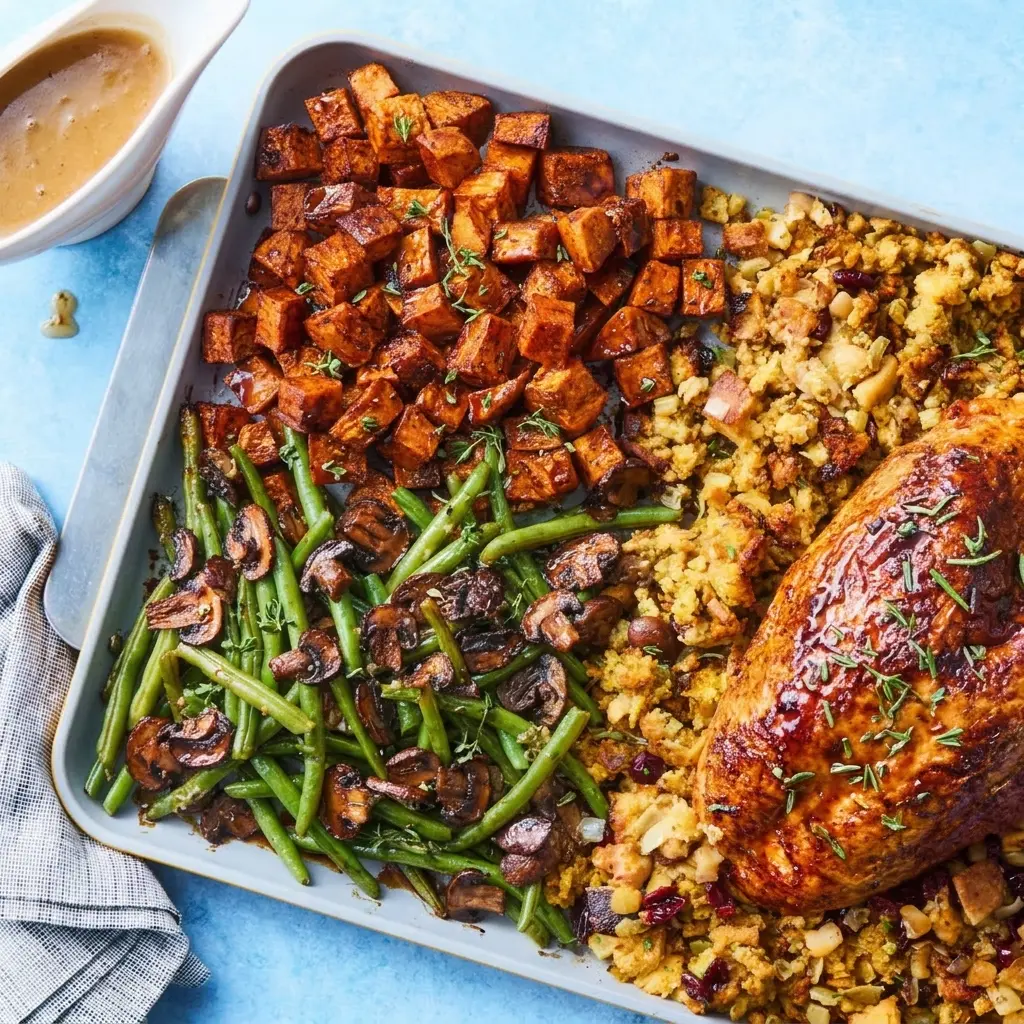
Even a simple recipe can become frustrating if a few important details are overlooked. Here are some common mistakes to avoid.
Overcrowding the Sheet Pan
Trying to fit too many ingredients onto one baking sheet is one of the biggest mistakes.
Overcrowding prevents hot air from circulating around the ingredients and can leave vegetables soft instead of golden.
Solution: Use a large rimmed baking sheet or divide the ingredients between two pans.
Cutting Vegetables Unevenly
Large sweet potato cubes and tiny carrot pieces won’t finish cooking at the same time.
Solution: Cut vegetables into similar-sized pieces and add quicker-cooking ingredients later.
Adding Everything to the Oven at Once
Turkey, stuffing, Brussels sprouts, and green beans all have different cooking requirements.
Solution: Follow a cooking schedule and add ingredients according to their individual cooking times.
Adding Too Much Broth to the Stuffing
Excessive broth can turn bread cubes into a soggy mixture.
Solution: Add the broth gradually, tossing between additions. The bread should be moist without becoming saturated.
Overcooking the Turkey
Turkey breast can become dry and firm when left in the oven for too long.
Solution: Check the thickest part with a meat thermometer and remove the turkey once it reaches the required internal temperature.
Forgetting to Rest the Turkey
Slicing the turkey immediately after roasting can make preparation more difficult.
Solution: Allow the turkey to rest for approximately 10–15 minutes before carving.
Delicious Variations and Ingredient Substitutions
One of the best things about this one-pan Thanksgiving dinner is that you can change the ingredients according to your preferences.
Whether you love traditional holiday flavors or want to experiment with different combinations, these variations offer plenty of inspiration.
1. Turkey Thigh Sheet-Pan Thanksgiving Dinner
If you prefer richer turkey meat, try using turkey thighs instead of turkey breast.
Turkey thighs have a deeper flavor and work beautifully with rosemary, thyme, garlic, and butter.
Arrange them on the sheet pan with sweet potatoes, Brussels sprouts, and carrots.
Because thighs have different cooking requirements from turkey breast, adjust the cooking time and check their internal temperature.
2. Turkey Tenderloin Variation
Turkey tenderloin is an excellent choice when you want smaller portions and easier slicing.
It is boneless and convenient to prepare, making it particularly suitable for couples or small families.
Season it with garlic butter, rosemary, paprika, and black pepper.
Pair it with roasted carrots, green beans, and traditional stuffing.
3. Sausage Thanksgiving Stuffing
For a richer stuffing, add cooked sausage to the bread mixture.
Brown approximately ½ pound of breakfast sausage in a skillet, breaking it into small pieces.
Add the onion and celery and cook until softened.
Combine everything with the bread cubes, broth, butter, and herbs.
This variation creates a hearty stuffing with delicious savory flavor.
4. Cornbread Thanksgiving Stuffing
Replace traditional bread cubes with dried cornbread cubes.
Cornbread gives the stuffing a slightly sweet, crumbly texture that pairs beautifully with roasted turkey.
Combine it with:
- Diced onion.
- Celery.
- Fresh sage.
- Melted butter.
- Chicken broth.
- Black pepper.
What to Serve with Sheet-Pan Thanksgiving Dinner
Although this Sheet-Pan Thanksgiving Dinner already includes several classic holiday favorites, you can add a few extra dishes to create a more elaborate Thanksgiving table.
The key is choosing complementary dishes without making the preparation unnecessarily complicated.
Classic Thanksgiving Accompaniments
Homemade Cranberry Sauce
Cranberry sauce is a traditional Thanksgiving favorite. Its sweet and slightly tart flavor pairs beautifully with roasted turkey and savory stuffing.
Creamy Turkey Gravy
A smooth homemade gravy adds richness to sliced turkey and stuffing. Serve it warm in a small gravy boat so everyone can add as much as they like.
Fluffy Dinner Rolls
Soft dinner rolls are perfect for serving alongside turkey and roasted vegetables. You can use homemade rolls or your favorite store-bought variety.
Creamy Mashed Potatoes
Mashed potatoes are another classic addition. Prepare them with butter, milk, and your preferred seasonings.
How to Store and Reheat Sheet-Pan Thanksgiving Dinner Leftovers
If you have leftovers after your holiday gathering, don’t worry! Turkey, stuffing, and roasted vegetables can all be stored for another meal.
How to Store Leftovers
Allow the food to stop steaming heavily, then divide it into separate, shallow airtight containers.
Store the following ingredients separately when possible:
- Sliced turkey breast.
- Stuffing.
- Roasted sweet potatoes.
- Brussels sprouts.
- Green beans and carrots.
- Gravy and cranberry sauce.
Refrigerate cooked leftovers within two hours of serving. According to USDA Thanksgiving leftover storage guidance, refrigerated leftovers should generally be used within four days.
Can You Freeze Sheet-Pan Thanksgiving Dinner?
Yes! Many components of this recipe can be frozen.
Turkey breast freezes particularly well when sliced and stored in airtight freezer containers.
Stuffing can also be frozen in individual portions.
Roasted vegetables may become softer after thawing, but they can still be used in other meals.
For easier storage:
- Divide food into individual portions.
- Remove excess air from freezer bags.
- Label each container with the preparation date.
- Freeze portions flat when using freezer bags.
How to Reheat Leftover Turkey
For the best results, reheat turkey in the oven.
- Preheat the oven to 325°F (165°C).
- Arrange turkey slices in an oven-safe dish.
- Add a small splash of broth.
- Cover the dish loosely with aluminum foil.
- Reheat until the turkey reaches 165°F (74°C).
The broth and foil help prevent the slices from drying out.
How to Reheat Stuffing and Vegetables
Transfer stuffing to an oven-safe dish and cover it with foil.
Add a small amount of broth if it seems dry.
Reheat vegetables separately, spreading them across a baking sheet to encourage even warming.
For a slightly crispier finish, uncover the vegetables toward the end of reheating.
Always check that reheated leftovers reach 165°F (74°C).
Frequently Asked Questions
1. Can you cook a whole Thanksgiving dinner on one sheet pan?
Yes! You can prepare turkey, stuffing, sweet potatoes, Brussels sprouts, and other vegetables together on a large sheet pan. The secret is arranging ingredients in separate sections and adding them according to their individual cooking times. Use a second pan if necessary.
2. What temperature should I cook a Sheet-Pan Thanksgiving Dinner at?
An oven temperature of 375–400°F (190–200°C) works well for many sheet-pan Thanksgiving recipes. However, cooking temperature and time depend on the turkey cut and its size. Always use a meat thermometer to check the turkey and stuffing.
3. How long does Sheet-Pan Thanksgiving Dinner take to cook?
For a smaller turkey breast, plan approximately 45–90 minutes of roasting, depending on its thickness, weight, and whether it is bone-in. Vegetables and stuffing may finish earlier. Allow additional time for preparation, resting, and arranging the meal.
Conclusion: Enjoy an Easy and Delicious Sheet-Pan Thanksgiving Dinner
This Sheet-Pan Thanksgiving Dinner is a wonderful way to enjoy traditional holiday flavors without complicated preparation or a kitchen full of dishes. With herb-seasoned turkey, savory stuffing, golden sweet potatoes, and beautifully roasted vegetables, everything comes together in one convenient meal. Customize the ingredients, prepare a few things ahead, and enjoy more time around the table with your loved ones. Give this easy Thanksgiving recipe a try, and don’t forget to share your favorite variations in the comments!