
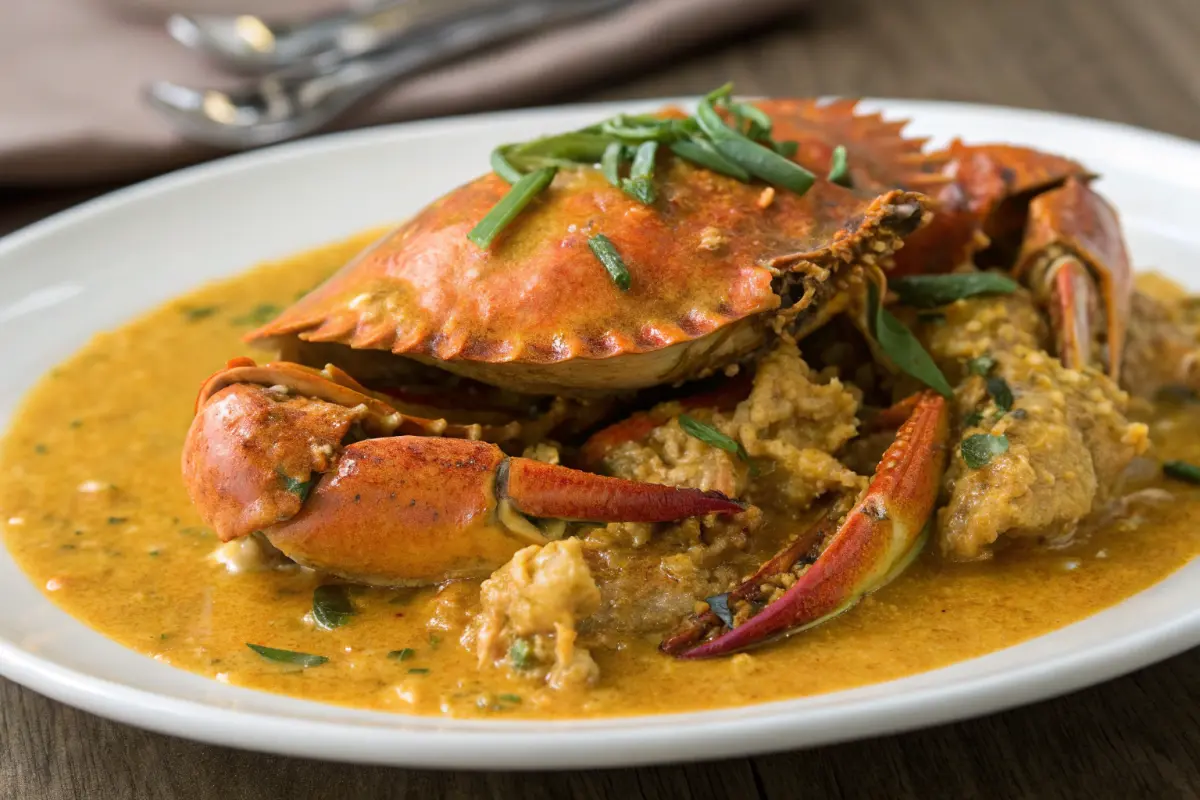
Why You’ll Love This Salted Egg Yolk Mud Crab Recipe
There are plenty of ways to cook mud crab, but salted egg yolk crab has a flavor profile that makes it particularly memorable.
Here are a few reasons this version works so well:
- Sweet mud crab meat balances the salty egg yolks.
- Butter gives the sauce a rich, glossy finish.
- Curry leaves add a distinctive Southeast Asian aroma.
- Bird’s-eye chili provides adjustable heat.
- Evaporated milk creates a smooth, creamy consistency.
- A light starch coating gives the crab a delicious texture.
- The sauce comes together quickly once the crab is cooked.
- It makes an impressive centerpiece for a family seafood dinner.
The secret is balance. Salted egg yolks are naturally intense, so the finished sauce should not taste simply salty. It should taste buttery, savory, aromatic, slightly sweet, and rich, with the natural sweetness of the crab still coming through.
What Is Salted Egg Yolk Mud Crab Recipe?
Salted egg yolk mud crab is a popular Southeast Asian-style seafood dish that combines crab with a rich sauce made from cooked salted duck egg yolks.
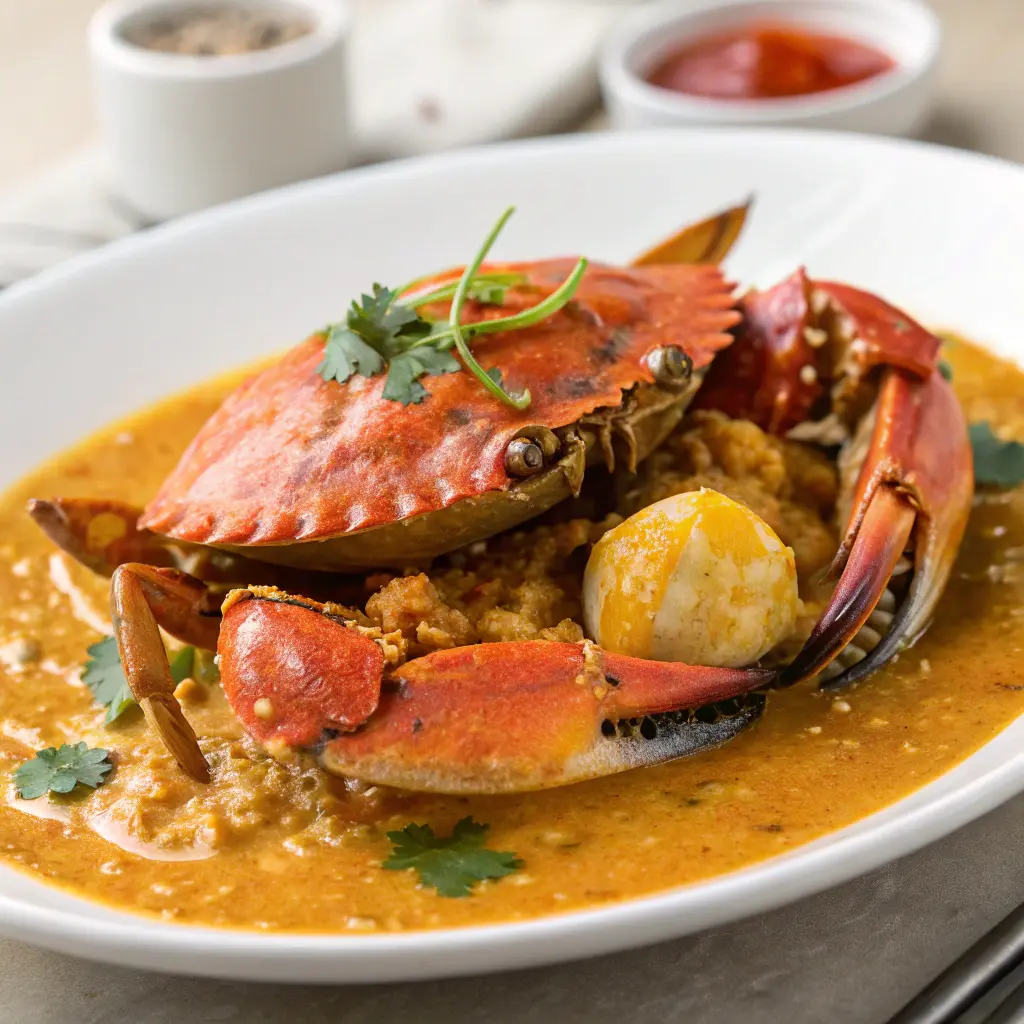
The salted yolks are usually steamed and mashed before being cooked with butter, garlic, curry leaves, chili, and a creamy liquid such as evaporated milk. As the yolks cook, they develop a distinctive golden color and a slightly grainy texture that gives the sauce its signature appearance.
Recipes from Singapore and Malaysia commonly follow this basic formula: prepare the crab separately, create the salted egg sauce, and then toss the crab through the sauce at the end. A Singapore-style version from Marigold, for example, uses mud crab, starch, butter, garlic, salted egg yolks, curry leaves, chili, evaporated milk, and sugar.
The finished dish is typically served hot, often alongside steamed rice or mantou so that none of the creamy sauce goes to waste.
Ingredients for Salted Egg Yolk Mud Crab Recipe
For approximately 3–4 servings, gather the following ingredients.
For the crab
- 2 medium mud crabs, approximately 1.2–1.3 kg total
- 1 large egg, beaten
- 4 tablespoons cornstarch or potato starch
- Neutral oil, for frying
For the salted egg yolk sauce
- 5–6 salted egg yolks, cooked and mashed
- 60 g unsalted butter
- 1 tablespoon minced garlic
- 1 handful fresh curry leaves
- 2–4 bird’s-eye chilies, thinly sliced
- 120–150 ml evaporated milk
- 1 tablespoon sugar
- White pepper, to taste
- Salt, only if needed
The quantities can be adjusted depending on how rich you want the sauce. Some established versions use as many as 10 salted egg yolks for roughly 1.28 kg of mud crab, while lighter versions use fewer yolks.
Why each ingredient matters
Mud crab: The star of the dish. Its naturally sweet meat works beautifully against the intense salted egg yolk sauce.
Salted egg yolks: These provide the characteristic savory, buttery, golden flavor.
Butter: Helps carry the aroma of the garlic, curry leaves, and chili while giving the sauce its glossy texture.
Curry leaves: One of the most important aromatic ingredients. Their fragrance immediately gives the dish its Southeast Asian character.
Bird’s-eye chili: Adds heat and freshness. Use less for a mild version or more if you prefer a fiery sauce.
Evaporated milk: Softens the intensity of the salted yolks and creates a creamy sauce that coats the crab.
Sugar: A small amount balances the saltiness of the yolks.
Cornstarch or potato starch: Creates a thin coating on the crab, helping it develop a lightly crisp exterior.
How to Clean and Prepare Mud Crab
Preparing a whole mud crab can look intimidating, but the process becomes straightforward once you know what to remove.
Step 1: Clean the crab
Rinse the crab under cold running water and scrub the shell gently to remove dirt or debris.
Step 2: Remove the top shell
Lift the top shell carefully and separate it from the body.
Step 3: Remove the gills
Remove the feathery gill structures from both sides of the body. These are not used in the finished dish.
Step 4: Remove unwanted internal material
Clean away the parts you do not want to serve. If there is usable crab roe, you can reserve it separately if desired.
Step 5: Cut the crab into pieces
Separate the body into manageable portions.
Cut or break apart:
- Body sections
- Large claws
- Legs
Crack the larger claws lightly with the back of a knife or a crab cracker. Do not smash them completely. The goal is simply to create openings through which the sauce can reach the meat.
Step 6: Dry the crab
This step is easy to overlook, but it matters.
Use paper towels to dry the crab pieces thoroughly before coating them. Excess moisture can cause hot oil to splatter and can prevent the starch coating from becoming crisp.
When handling raw crab, keep it separate from cooked ingredients and clean your work surface, utensils, and hands after contact with raw seafood.
How to Prepare Salted Egg Yolks
The salted egg yolks should be cooked before they go into the sauce.
If you have whole salted duck eggs:
- Crack the eggs carefully.
- Separate the yolks from the whites.
- Place the yolks in a steamer.
- Steam until cooked through.
- Allow them to cool slightly.
- Mash them thoroughly with a fork.
You want the yolks to become a fairly fine paste.
Do not leave large chunks throughout the mixture. Smaller pieces break down much more easily when cooked with butter.
A good salted egg yolk mixture should look crumbly and golden before it goes into the pan.
As the mashed yolks cook in butter, they become more aromatic and begin to foam. That foaming stage is an important visual cue that the yolks are releasing their characteristic flavor.
If you use pre-cooked salted egg yolks, simply mash them before starting the sauce.
How to Make Salted Egg Yolk Mud Crab
Step 1: Coat the Crab
Place the cleaned and thoroughly dried crab pieces in a large bowl.
Dip each piece lightly into beaten egg. Allow excess egg to drip away, then transfer the crab to the cornstarch.
Toss gently until each piece has a thin coating.
Shake off excess starch.
You do not want a thick batter. The purpose of the coating is to give the crab a delicate crisp exterior rather than a heavy fried crust.
A similar preparation is used in established Singaporean and Malaysian recipes, where crab is coated with beaten egg followed by cornstarch or potato starch before frying.
Step 2: Fry the Crab
Heat enough neutral oil in a wok or deep frying pan to fry the crab pieces comfortably.
Work in batches rather than putting everything into the pan at once.
Carefully add the crab and fry until the coating is lightly crisp and the crab has developed a reddish-orange shell.
Remove the pieces and place them on a rack or paper towels to drain.
The crab does not need to become deeply browned.
In fact, over-frying is one of the easiest ways to ruin this dish. The crab will be returned to the sauce later, so you want the initial frying stage to give it structure and light crispness without drying out the meat.
Step 3: Prepare the Aromatics
Use a clean wok or large skillet.
Add a small amount of oil and heat over medium heat.
Add:
- Minced garlic
- Curry leaves
- Sliced bird’s-eye chili
Stir for several seconds until fragrant.
The curry leaves should become aromatic, but the garlic should not turn dark brown.
Burned garlic introduces a bitter flavor that can overpower the salted egg yolk.
If you are sensitive to chili heat, this is the stage where you can adjust the amount.
For a mild salted egg yolk crab recipe, use one or two chilies.
For a spicy version, use three or four, or add more according to your preference.
Step 4: Add the Butter
Add the unsalted butter to the fragrant garlic and curry leaves.
Lower the heat slightly and allow the butter to melt.
Keep stirring so the aromatics become evenly coated.
The goal is to create a fragrant buttery base for the salted egg yolks.
Avoid very high heat at this stage.
The butter should melt gently rather than smoke or burn.
Step 5: Add the Salted Egg Yolks
Add the mashed salted egg yolks to the melted butter.
Stir continuously.
At first, the mixture may look crumbly. Keep stirring and pressing the yolks against the bottom of the wok.
Within a short time, the mixture should become more cohesive.
You may notice small bubbles or foam developing around the yolks.
This is the point where the sauce begins to develop its characteristic salted egg aroma.
Do not rush this stage, but do not leave the yolks unattended either.
Medium to medium-low heat gives you much better control than blasting the mixture over high heat.
Step 6: Add Evaporated Milk
Slowly pour in the evaporated milk while stirring continuously.
The sauce will loosen immediately.
Keep stirring until the milk and yolk mixture become evenly incorporated.
Add the sugar and a little white pepper.
Taste carefully before adding salt.
Salted egg yolks vary in saltiness, so adding salt automatically can easily push the finished sauce too far.
The sauce should taste:
- Savory
- Buttery
- Rich
- Slightly sweet
- Aromatic
- Mildly spicy if chili is used
The sauce should also be thick enough to coat the back of a spoon.
Established salted egg seafood recipes commonly use evaporated milk to loosen the yolk mixture while retaining a rich, creamy consistency.
Step 7: Return the Crab to the Wok
Once the sauce has thickened slightly, add the fried crab pieces.
Increase the heat slightly and toss everything together.
Use a large spatula or wok spoon to turn the crab gently.
Make sure the sauce reaches:
- The shell
- The body pieces
- The claws
- The exposed meat
Crack the claws slightly if you have not already done so.
Keep the tossing stage relatively brief.
The objective is to coat the crab, not simmer it for another ten minutes.
The Meatmen’s version similarly finishes the dish by transferring the fried crab into the prepared sauce and quickly tossing it until evenly coated.
Step 8: Serve Immediately
Transfer the crab to a large serving platter.
Spoon any remaining sauce from the wok over the top.
You can finish the dish with:
- Fresh curry leaves
- Sliced spring onion
- Extra chili
- Lime wedges
Serve immediately while the sauce is hot and the coating still has some crispness.
Common Mistakes to Avoid
1. Frying the crab for too long
Long frying can make crab meat dry and firm.
You only need enough frying to cook the crab and create a lightly crisp surface.
2. Using too much starch
A thick layer of starch can make the crab heavy.
Use enough to create a thin coating.
3. Burning the garlic
Dark garlic becomes bitter quickly.
Keep the heat moderate and stir constantly.
4. Burning the curry leaves
Curry leaves should smell fragrant, not scorched.
Add them with the garlic and butter and watch the pan closely.
5. Cooking the salted egg yolks over excessive heat
High heat can make the sauce greasy and uneven.
Medium heat gives you better control.
6. Adding salt without tasting
Salted egg yolks are already salty.
Always taste the sauce first.
Variations on Salted Egg Yolk Mud Crab
One of the best things about this recipe is how easily you can adjust it.
Spicy Salted Egg Yolk Crab
For a hotter version, increase the bird’s-eye chili.
You can also add sliced red chili for a brighter color.
For serious heat, leave some chili seeds intact.
Extra-Creamy Salted Egg Crab
Increase the evaporated milk slightly for a smoother sauce.
You can also add a small splash of coconut milk for a richer Southeast Asian-style variation.
Keep the amount controlled so the salted egg yolk remains the dominant flavor.
Dry-Style Salted Egg Crab
For a thicker, more concentrated sauce:
- Use less evaporated milk.
- Cook the yolk mixture slightly longer.
- Allow the sauce to reduce before adding the crab.
- Toss quickly at the end.
This creates a more intensely flavored coating.
No-Deep-Fry Salted Egg Crab
If you prefer not to deep-fry the crab, steam or pan-cook it instead.
This version will be less crispy, but the salted egg sauce will still work beautifully.
The texture will be closer to a saucy steamed crab dish rather than a crispy restaurant-style version.
What to Serve With Salted Egg Yolk Mud Crab Recipe
Because the sauce is rich and flavorful, simple sides work best.
Steamed White Rice
Steamed jasmine or white rice is one of the easiest choices.
The neutral flavor lets the crab remain the focus while giving you something to soak up the sauce.
Mantou
Steamed or fried mantou is an excellent pairing.
Tear off a piece and use it to scoop up the remaining salted egg sauce.
Stir-Fried Greens
Keep the vegetables simple.
Good options include:
- Bok choy
- Chinese broccoli
- Choy sum
- Snow peas
- Stir-fried cabbage
The fresh crunch provides a nice contrast to the rich crab.
Fresh Lime
A few drops of lime juice can brighten the finished dish.
Do not add too much directly to the sauce. Instead, serve lime wedges on the side so everyone can adjust the flavor.
Cucumber
Fresh cucumber makes an easy side for a rich seafood spread.
Its clean, crisp texture works particularly well alongside buttery salted egg sauce.
Storage and Reheating
Salted egg yolk mud crab is best served immediately.
The longer the crab sits, the more the fried coating softens.
If you have leftovers, place them in a clean airtight container and refrigerate promptly.
For the best texture, reheat gently in a skillet or wok.
To reheat:
- Add the crab to a skillet over low to medium heat.
- Add a small splash of evaporated milk if the sauce has become very thick.
- Cover briefly to warm the crab.
- Toss gently.
- Serve as soon as it is hot.
Avoid repeatedly reheating the same seafood.
When storing cooked seafood, follow appropriate refrigeration practices and keep it separate from raw seafood during preparation.
Frequently Asked Questions
What is salted egg yolk crab made of?
Salted egg yolk crab is made with crab and a sauce based on cooked salted duck egg yolks. The sauce commonly includes butter, garlic, curry leaves, chili, evaporated milk, and sugar.
The crab is generally cooked separately before being tossed with the finished sauce.
Can I use frozen mud crab?
Yes.
Frozen mud crab can work well if it is properly thawed and thoroughly drained.
Thaw it in the refrigerator, remove excess moisture, and pat the crab completely dry before coating.
The drier the crab, the better the frying process will be.
How many salted egg yolks do I need for crab?
For roughly 1–1.3 kg of crab, 5–6 salted egg yolks is a good starting point for a rich sauce.
If you want an especially intense salted egg flavor, increase the amount.
Some established recipes use up to 10 yolks for a similar quantity of crab, so there is plenty of room to adjust according to taste.
Why is my salted egg yolk sauce not creamy?
There are several possible reasons.
- The yolks may not have been mashed finely enough.
- Too much liquid may have been added.
- The sauce may not have cooked long enough.
- The heat may have been too high.
- The butter and milk may have separated.
Cook the sauce gradually and stir continuously.
Why does my salted egg yolk sauce become oily?
Usually, excessive heat is the problem.
Butter can separate from the other ingredients if the sauce becomes too hot.
Lower the heat and stir continuously.
Conclusion
This Salted Egg Yolk Mud Crab Recipe brings together everything that makes Southeast Asian seafood so irresistible: sweet, tender mud crab, rich salted egg yolks, fragrant curry leaves, garlic, butter, and a touch of chili. The result is a golden, creamy sauce that coats every piece of crab beautifully.